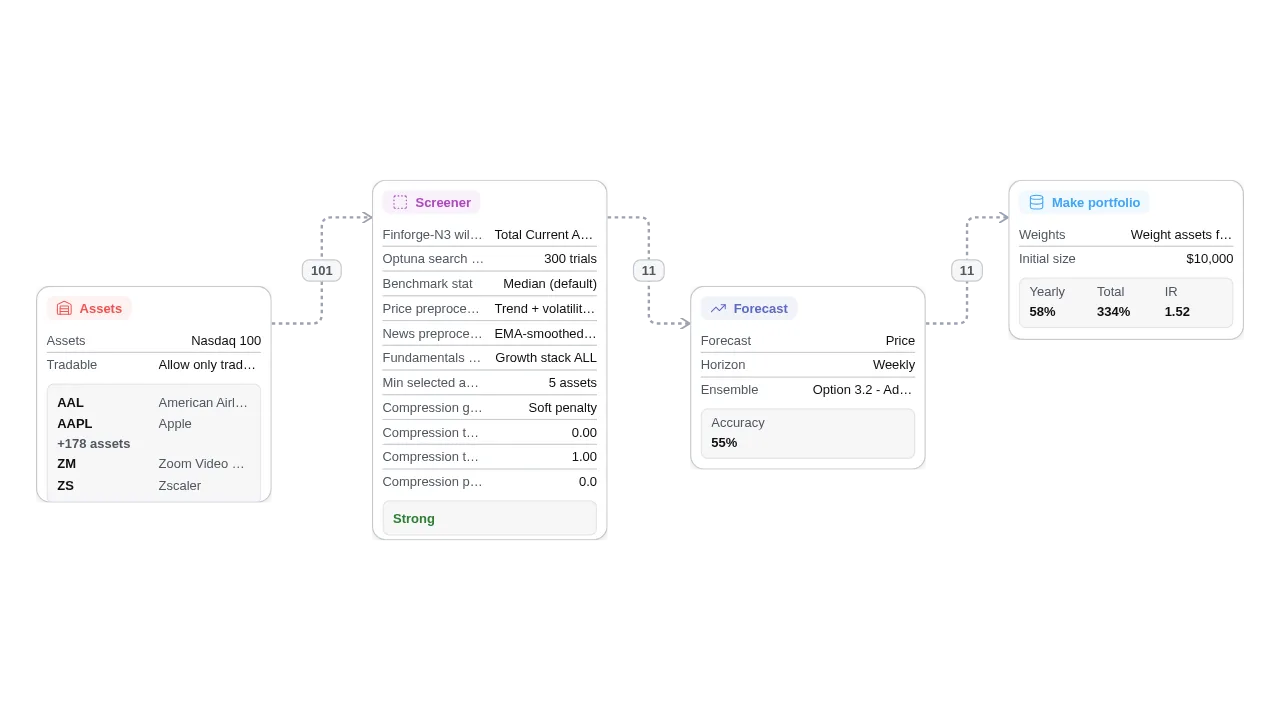
Nasdaq 100

This Finforge-N3 AI model flow starts with the Nasdaq-100 as the asset universe, then chains together two AI model nodes: Screener-N3 and Forecast-N3.
The idea is simple: first narrow the universe to more interesting candidates, then forecast their near-term return potential before sending the results into portfolio construction. This creates a practical workflow where screening, forecasting, and position sizing work together instead of as separate steps.
In this template, Screener-N3 uses data types including Total Current Assets and Solvency Ratio. Total Current Assets is the sum of assets the company expects to convert to cash or use within roughly the next year (for example, cash, receivables, and inventory), which helps describe near-term resources and operating flexibility. Solvency Ratio is a high-level measure of financial strength that helps indicate whether a company can meet its obligations over time.
Together, these inputs give the screener both a near-term resources lens (what the company has available soon) and a durability lens (overall financial strength).
Screener-N3 is an AI model node that continually learns from new market dynamics instead of relying on fixed screening rules. Its role is to filter the Nasdaq-100 toward stocks with stronger potential versus the benchmark.
The selected names are then passed to Forecast-N3, another AI model node, built for continual deep learning forecasting. Forecast-N3 focuses more directly on price dynamics and estimates near-term return direction and magnitude.
Chaining the two nodes is meaningful because they solve different parts of the problem. Screener-N3 helps reduce noise by finding better candidates, while Forecast-N3 complements it by analyzing price behavior and short-term timing. Those forecasts then flow into portfolio construction, where stronger conviction can translate into larger position sizes.