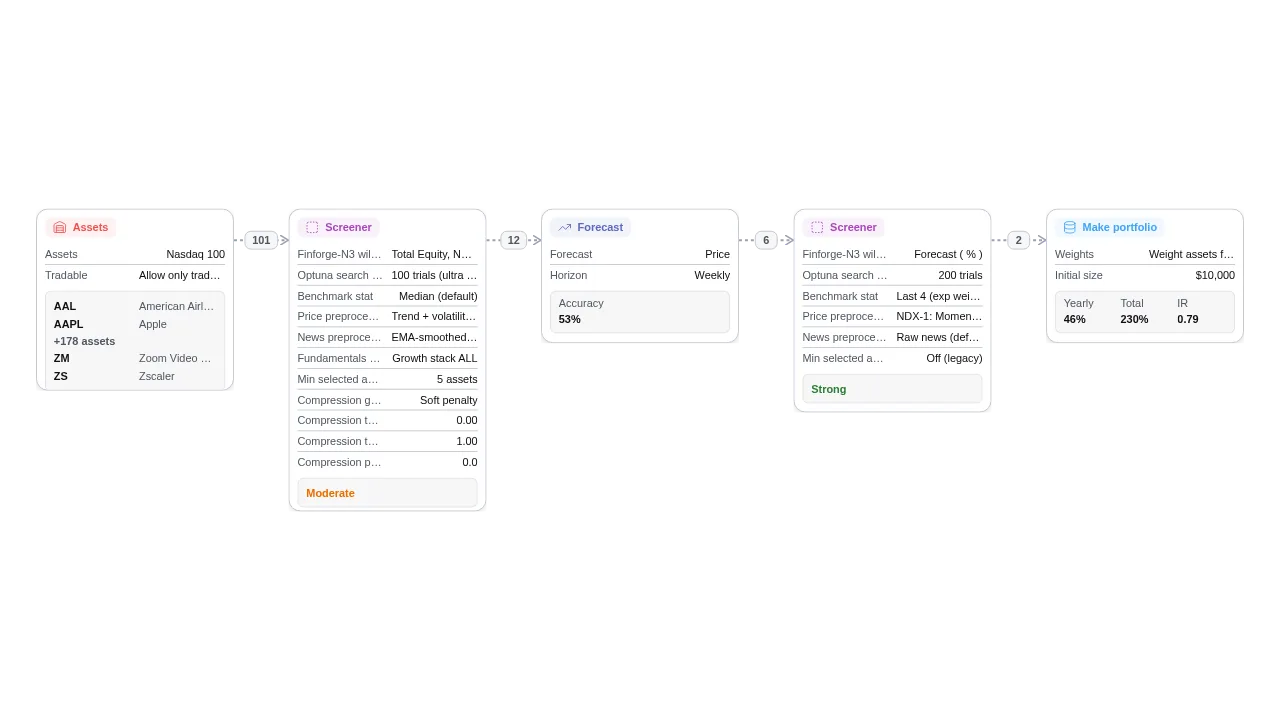
This template uses the datatype pair Total Equity and Net margin. It updates portfolio composition more frequently and is structurally more responsive to changing signals. Historical behavior generally shows higher turnover dynamics, with faster transitions in holdings and style exposures than persistence-oriented profiles. This can improve adaptability in shifting markets, but it also means the portfolio identity can evolve more quickly through time.
Screener-N3 continually learns which combinations improve selection quality over time.
The screened assets are then passed into Forecast-N3, which estimates near-term return direction and magnitude.
Forecast output is then passed through a second Screener-N3 as a post-model gate, so only names that satisfy forecast-aware rules proceed to portfolio construction.
Portfolio construction assigns larger weights to stronger forecasts within that filtered set.
The result is a more selective, higher-conviction structure that can improve signal purity but may reduce breadth.
That makes node chaining meaningful: first screening reduces noise, forecasting adds timing, second screening enforces quality control, and portfolio construction turns all stages into actionable allocations.