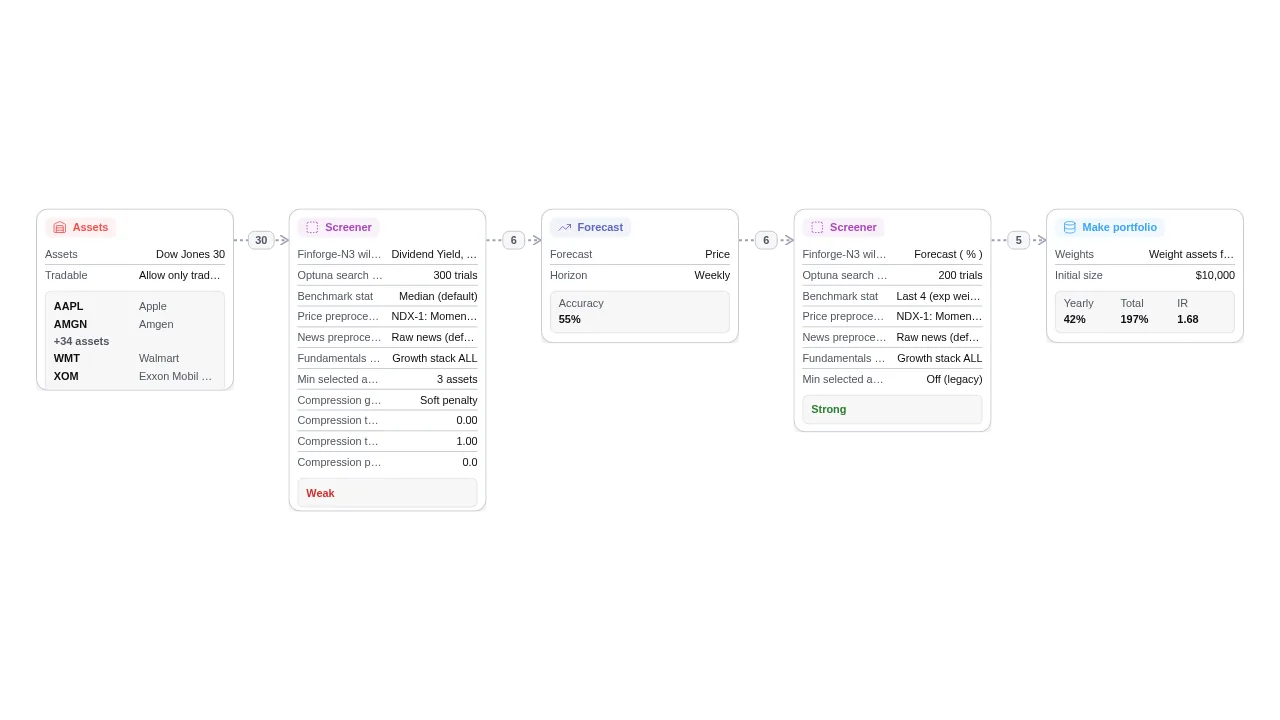
This template uses the datatype pair Dividend Yield and Total Liabilities. It emphasizes downside control and portfolio stability over aggressive upside pursuit. Historically this profile is associated with lower realized volatility, lower active-risk behavior, and shallower drawdown patterns relative to high-octane styles. In practical terms, it often behaves as a risk-tempering allocation profile that aims for smoother benchmark-relative participation across regimes.
Screener-N3 continually learns which combinations improve selection quality over time.
The screened assets are then passed into Forecast-N3, which estimates near-term return direction and magnitude.
Forecast output is then passed through a second Screener-N3 as a post-model gate, so only names that satisfy forecast-aware rules proceed to portfolio construction.
Portfolio construction assigns larger weights to stronger forecasts within that filtered set.
The result is a more selective, higher-conviction structure that can improve signal purity but may reduce breadth.
That makes node chaining meaningful: first screening reduces noise, forecasting adds timing, second screening enforces quality control, and portfolio construction turns all stages into actionable allocations.