Dow Jones

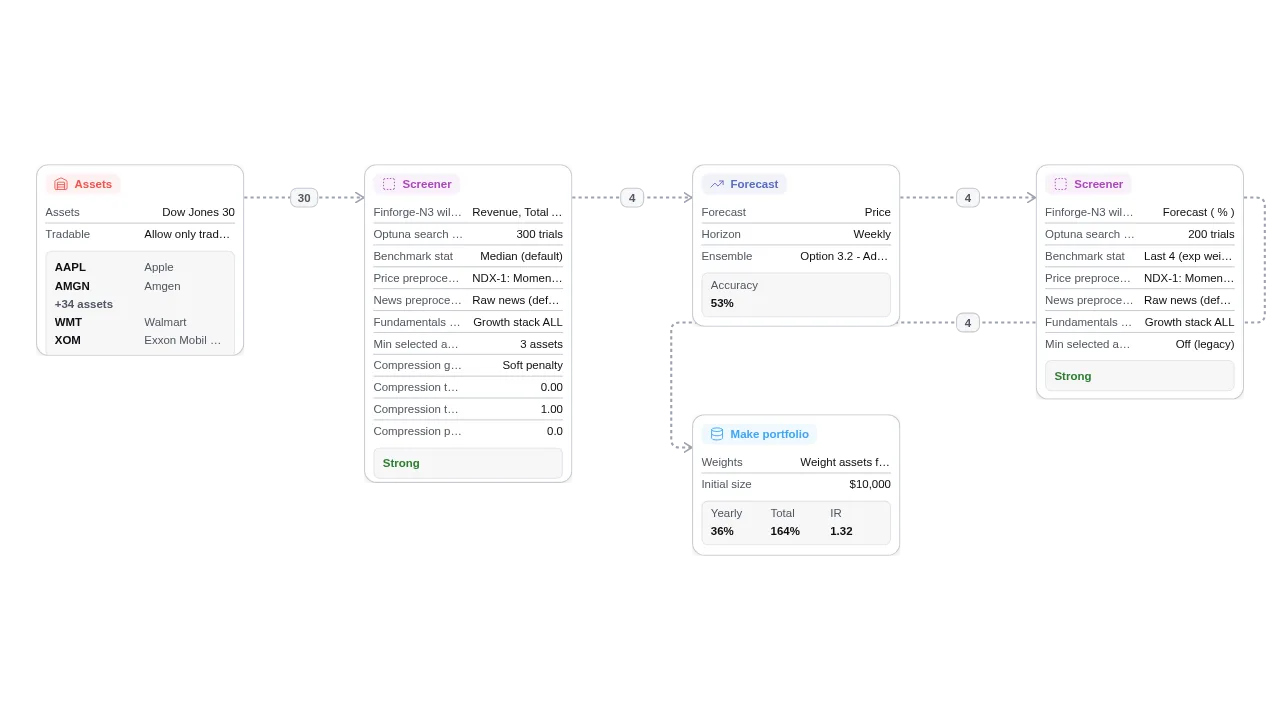
This Finforge-N3 AI model flow starts with the DIJA-30 as the asset universe, then chains together three AI model nodes: Screener-N3, Forecast-N3, and a second Screener-N3 before portfolio construction.
The idea is simple: first narrow the universe to more interesting candidates, then forecast their near-term return potential, then select the Top N forecasts to optimize against a benchmark before sending the results into portfolio construction. This creates a practical workflow where screening, forecasting, selection, and position sizing work together instead of as separate steps.
In this template, the first Screener-N3 uses data types Revenue and Total Assets. Revenue is the top-line sales figure, which helps describe the company’s scale and demand; growth and consistency in revenue can signal whether the business is expanding or stalling. Total Assets is the value of everything the company owns on its balance sheet; it helps describe the company’s scale and asset base that supports operations.
Together, these inputs give the screener a business scale lens: how large the company is by sales and by balance-sheet footprint.
Screener-N3 is an AI model node that continually learns from new market dynamics instead of relying on fixed screening rules. Its role is to filter the DIJA-30 toward stocks with stronger potential versus the benchmark.
The selected names are then passed to Forecast-N3, another AI model node, built for continual deep learning forecasting. Forecast-N3 focuses more directly on price dynamics and estimates near-term return direction and magnitude.
After forecasting, the second Screener-N3 ranks and selects the Top N forecasts to create a tighter candidate set for benchmark-aware optimization in portfolio construction.
Chaining the nodes is meaningful because they solve different parts of the problem. The first Screener-N3 reduces noise by finding better candidates, Forecast-N3 adds timing by estimating near-term return potential, and the second Screener-N3 concentrates the signal by selecting the strongest forecasts before optimization and position sizing.